


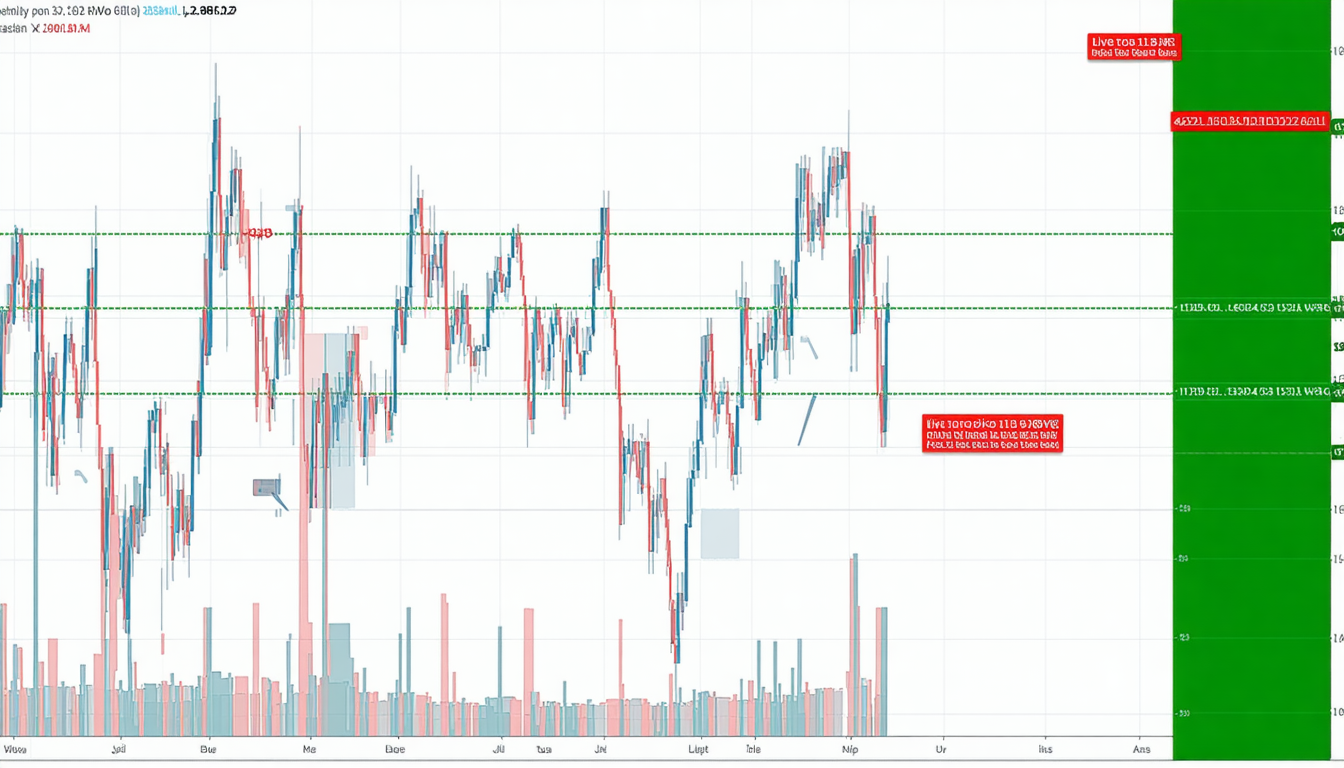
When you search for "X stock price," you're likely referring either to United States Steel Corporation (trading on the NYSE under the symbol X) or wondering about the trading status of Elon Musk’s social media company, X (formerly Twitter). The two are entirely separate entities—with dramatically different investment considerations.
What Is "X" on the NYSE? (United States Steel Corporation)
Current Price and Market Snapshot
As of the most recently available data, United States Steel Corporation (ticker X) closed around $54.85, showing a solid gain of about +5.1% in intraday movement. Its 52-week range spans from approximately $26.92 to $54.91 (cnbc.com).
Delving deeper into financials, U.S. Steel boasts a market capitalization near $12.4 billion, with trailing P/E at a steep 186×, and forward P/E around 22× (cnbc.com). This elevated valuation may reflect cyclical optimism or short-term bullish sentiment, but investors are still weighing profitability metrics like an ROE under 1% and slim net margins (cnbc.com).
Why This “X” Stock Still Matters
Many long-time investors are familiar with X as a classic industrial heavyweight—and the recent rebound is attracting attention from value-seeking traders. A quick technical glance even signals “Buy” across various moving averages, suggesting a short-term uptick in momentum (stockmonitor.com).
What About "X" (formerly Twitter)? Is There a Stock Price Today?
Privatization and Ticker Status
Since its 2022 purchase of Twitter, Elon Musk has taken the platform private. By 2023 it evolved into X Corp., and finally—through a March 2025 all-stock merger—it was acquired by Musk’s AI company xAI, as part of the X.AI Holdings Corp structure (en.wikipedia.org).
In practical terms, that means X (the social media company) does not trade on any public exchange. Its former ticker, TWTR, ceased in November 2022. Presently, there's no live stock quote or ticker symbol for X, making it inaccessible to retail investors (ultimamarkets.com).
Valuation Context (Private Perspective)
Despite being private, X and its parent group xAI have seen various private valuations. In March 2025, X was valued around $33 billion, and xAI estimated at $80 billion—when factoring in about $12 billion of debt, total corporate valuation could reach $45 billion (ft.com).
Quick Comparison: U.S. Steel (X) vs. X (formerly Twitter)
| Company | Ticker Symbol | Trading Status | Market Valuation |
|----------------------------------|-------------------|------------------------|-------------------------|
| United States Steel Corporation | NYSE: X | Publicly traded | ~$12 billion |
| X (formerly Twitter) | None (TWTR delisted) | Private ownership | ~$33–$45 billion (privately valued) |
Expert Insight
“Investors often get tripped up by symbol overlap—‘X’ on an exchange could mean steel, not social media. Context is everything when interpreting stock quotes.”
This nugget underlines the importance of double-checking company identity—not just ticker—especially when corresponding names overlap.
Why This Matters for Investors
-
Clarity in data feeds: Auto-generated price updates or RSS feeds mentioning “X” may confuse one company for the other. Always validate the context.
-
Strategic exposure: You can buy U.S. Steel (X) through any brokerage like any other stock. But investing in X (formerly Twitter) requires private capital or waiting for a potential IPO—there’s currently no public route.
-
Valuation signals: The long-delisted X (social media) still commands a substantial private valuation. That type of asset might attract institutional attention—especially once—or if—it returns to the public markets.
Closing Summary
In short: if you’re looking to trade or track “X stock price”, you're almost certainly dealing with United States Steel Corporation (NYSE: X), which is trading around the mid-$50s. By contrast, the X social media company is privately held and not accessible to public market traders. As always, double-check ticker context and trading status before making investment decisions.
Understanding these distinctions could save you from confusing a major industrial stock with a rebranded tech giant—and help set realistic expectations about liquidity and accessibility moving forward.
Let me know if you’d like to explore technical analysis of U.S. Steel (X) or keep an eye on future developments toward an IPO for X!











Leave a comment