Home Chainlink vs Quant: Key Differences, Use Cases, and Which to Choose

Chainlink vs Quant: Key Differences, Use Cases, and Which to Choose

Share
B8b5377b 893a 4b74 Aa0e 9c540c80591d 20x11
Share

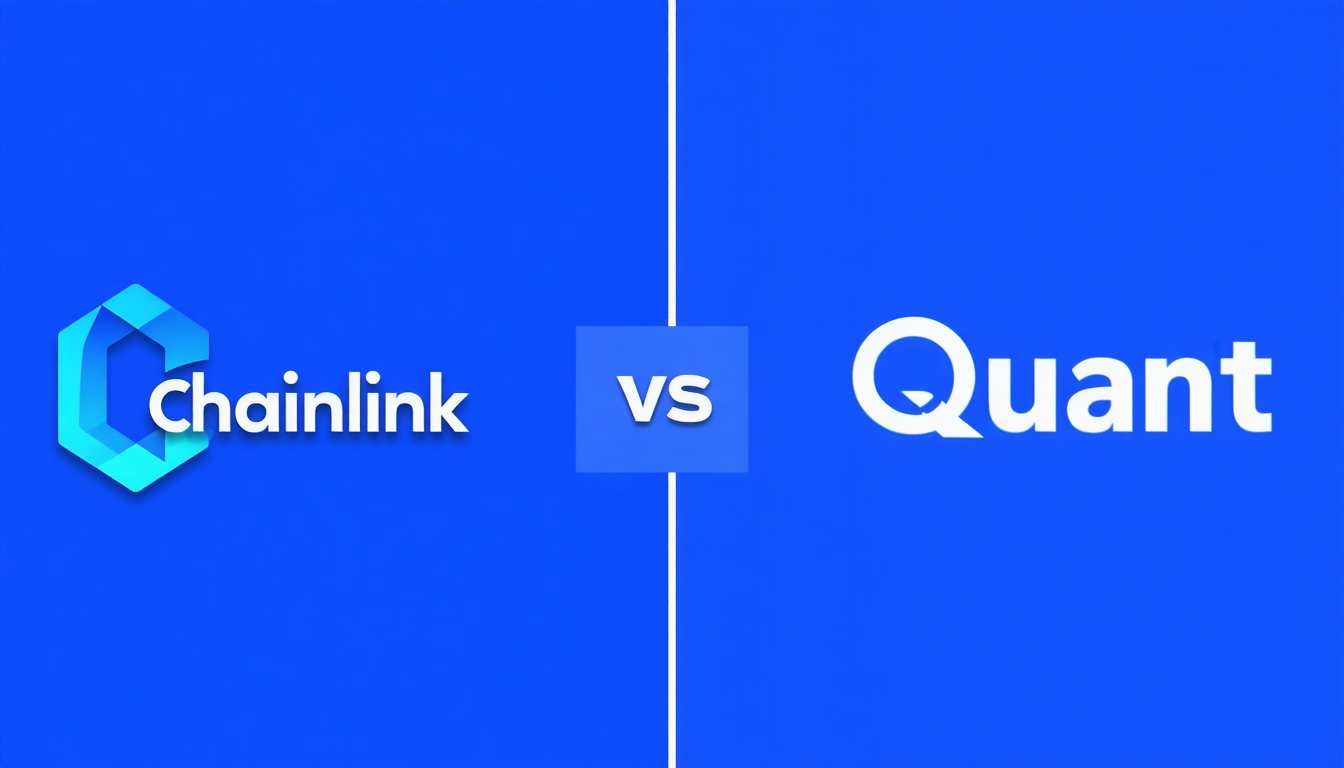
In the ever-evolving world of blockchain infrastructure, two projects—Chainlink (LINK) and Quant (QNT)—stand out, yet they serve distinct roles. Both are crucial scaffolds enabling modern decentralized systems, but each takes its own path. Chainlink excels in decentralized oracle services and cross-chain messaging, while Quant targets enterprise interoperability with its Overledger operating system. A comparison like “Chainlink vs Quant” isn’t just apples and oranges—it’s more like comparing seeds and soil: they support growth in different ways.

Below, we unpack their differences, real-world relevance, token dynamics, and which suits your strategy best.


Real-Time Market Snapshot: LINK and QNT Today

Before diving deeper, here’s where both tokens stand right now:

  • Chainlink (LINK) trades around $11.85–$11.96, with a market cap hovering just over $8.4 billion. Volume over 24 hours spans roughly $300–$500 million, reflecting moderate liquidity and stable usage trends (coingecko.com).

  • Quant (QNT), by contrast, sits at approximately $74.68, with a market cap near $900 million and significantly lower daily trading volume—around $20 million (coinmarketcap.com).

On the price-action front, LINK has faced short-term pressure—trending under moving averages and reflecting waning retail demand—while Quant recently saw a strong session, jumping over 8% and breaking above its 100-day moving average, signaling renewed bullish momentum (crypto.news).


H2: Core Architectural Differences

H3: Chainlink – The Decentralized Oracle Powerhouse

Chainlink serves as a decentralized oracle network. At its core, independent nodes fetch and verify off-chain data—like price feeds or random values—and deliver that data on-chain with transparency and trust minimization. Its services now span automation, staking, CCIP for cross-chain messaging, proof-of-reserve, VRF for randomness, data streams, and tokenized asset settlement (galaxy.com).

  • Use Cases:
  • Price feeds for DeFi platforms
  • Smart contract automation and verifiable executions
  • Cross-chain messaging and token transfers
  • Real-world asset data and proof-of-reserves

H3: Quant – The Enterprise Interoperability Layer

Quant uses a fundamentally different model: instead of decentralized nodes, it offers Overledger—a middleware “operating system” that connects enterprises, banks, and institutions to multiple blockchains via APIs and gateways. It’s tailored for regulated environments, enabling CBDC pilots, inter-chain payments, and integration with legacy systems without full system overhauls (atomicwallet.io).

  • Use Cases:
  • CBDC and bank settlement networks
  • Enterprise-grade interoperability for private/public chains
  • Regulated payment flows and enterprise blockchain integrations

Divergent Token Dynamics: LINK vs QNT

H3: LINK – Incentivizing Trust in DeFi

LINK acts as a utility and security token within Chainlink’s decentralized networks. Node operators earn LINK for delivering accurate data, and staking mechanisms secure the ecosystem. Its demand scales with DeFi activity, as more contracts rely on Chainlink’s services (atomicwallet.io).

H3: QNT – Access by Design

Quant’s QNT works more like a licensed key: enterprises must hold or lock QNT to access Overledger’s API functionality. Its demand is rooted in institutional adoption rather than retail speculation—and its relatively low supply adds scarcity value (atomicwallet.io).


Adoption Patterns: Web3 vs Traditional Institutions

  • Chainlink is thoroughly entrenched in Web3. Thousands of dApps on Ethereum, Polygon, Avalanche, Base, BNB Chain, and more use its oracles. Enterprises are also adopting its CCIP messaging layer, with partners like SWIFT and ANZ onboarded (atomicwallet.io).

  • Quant is more niche, serving banks, governments, and regulated pilots. Its Overledger OS underlies CBDC experimentation and cross-border payment projects—but adoption is slower, by necessity (atomicwallet.io).


Strengths, Trade-offs, and Strategic Fit

H3: Chainlink Strengths & Caveats

Strengths:
- Broad DeFi integration and ecosystem dominance
- Robust infrastructure and decentralization
- CCIP gaining traction as cross-chain standard
- Deepening exposure in real-world asset space

Caveats:
- Sensitive to DeFi market cycles
- Faces competition from built-in oracles in some chains
- Scaling CCIP globally remains complex (atomicwallet.io).

H3: Quant Strengths & Caveats

Strengths:
- Enterprise-focused, compliant architecture
- Integrates without overhauling legacy infrastructure
- Positioned for CBDC and regulated blockchain use
- Scarcity-driven token model (low supply QNT)

Caveats:
- Less visible in public crypto markets
- Adoption constrained by slow-moving institutions
- Perception of centralization may deter some users (atomicwallet.io).


Expert Insight

“Chainlink is shaping the decentralized backbone of DeFi and cross-chain operations, while Quant brings institutional-grade interoperability to the table.”
– Industry infrastructure strategist


Strategic Decision Guide: Which One to Choose?

  • If you’re building dApps, DeFi protocols, or cross-chain services, Chainlink is the obvious and battle-tested choice.
  • If your focus is on enterprise deployment, CBDC infrastructure, or legacy-to-chain integration, Quant aligns better—even if silently.

Consider your horizon:
- Traders may find LINK more liquid and responsive to ecosystem developments.
- Long-term investors or institutions might view QNT as a play on next-gen regulated blockchain adoption.


Conclusion

Chainlink and Quant occupy complementary lanes. LINK powers decentralized finance and data integrity across chains, while QNT supports institutional interoperability and compliant blockchain adoption. Neither is “better”—they’re different tools for different users.

For developers entrenched in Web3, Chainlink is the go-to. For enterprises building regulated blockchain infrastructure, Quant offers a smoother path. Recognizing where each excels is key to choosing the right infrastructure piece for your blockchain strategy.


Gif;base64,R0lGODlhAQABAAAAACH5BAEKAAEALAAAAAABAAEAAAICTAEAOw==

Share
Written by
Christine Reyes

Experienced journalist with credentials in specialized reporting and content analysis. Background includes work with accredited news organizations and industry publications. Prioritizes accuracy, ethical reporting, and reader trust.

Leave a comment

Leave a Reply

Your email address will not be published. Required fields are marked *

${ad.title}

${ad.sponsor_name} ${getRandomCTA()}
`; } else if (LAYOUT === 'carousel') { adEl.style.cssText = 'min-width:280px !important;scroll-snap-align:start !important;display:flex !important;flex-direction:column !important;border:1px solid #e2e8f0 !important;border-radius:8px !important;overflow:hidden !important;text-decoration:none !important;background:#fff !important;'; adEl.innerHTML = `

${ad.title}

${ad.sponsor_name} ${getRandomCTA()}
`; } else if (LAYOUT === 'banner') { adEl.style.cssText = 'min-width:200px !important;display:flex !important;flex-direction:column !important;border:1px solid #e2e8f0 !important;border-radius:8px !important;overflow:hidden !important;text-decoration:none !important;background:#fff !important;transition:transform 0.2s,box-shadow 0.2s !important;cursor:pointer !important;'; adEl.innerHTML = `

${ad.title}

${ad.sponsor_name} ${getRandomCTA()}
`; } else if (LAYOUT === 'feed') { adEl.style.cssText = 'display:flex !important;flex-direction:column !important;border:1px solid #e2e8f0 !important;border-radius:8px !important;overflow:hidden !important;text-decoration:none !important;background:#fff !important;transition:transform 0.2s,box-shadow 0.2s !important;cursor:pointer !important;'; adEl.innerHTML = `

${ad.title}

${ad.sponsor_name} ${getRandomCTA()}
`; } else { adEl.style.cssText = 'display:flex !important;flex-direction:column !important;height:100% !important;border:1px solid #e2e8f0 !important;border-radius:8px !important;overflow:hidden !important;text-decoration:none !important;transition:transform 0.2s,box-shadow 0.2s !important;cursor:pointer !important;background:#fff !important;'; adEl.innerHTML = `

${ad.title}

${ad.sponsor_name} ${getRandomCTA()}
`; } return adEl; } function renderAds(ads) { const container = document.getElementById(WIDGET_ID); if (!container) return; container.innerHTML = ''; const layoutStyles = { horizontal: `display:grid;grid-template-columns:repeat(${GRID_COLUMNS},1fr);gap:16px;margin:16px 0;width:100%;`, vertical: 'display:flex;flex-direction:column;gap:10px;margin:16px 0;max-width:320px;', carousel: 'display:flex;overflow-x:auto;gap:12px;scroll-snap-type:x mandatory;padding:16px 0;', banner: 'display:flex;overflow-x:auto;gap:10px;padding:10px 0;', feed: 'display:flex;flex-direction:column;gap:16px;max-width:800px;margin:0 auto;padding:16px;', grid: `display:grid;grid-template-columns:repeat(${GRID_COLUMNS},1fr);gap:16px;margin:16px 0;width:100%;` }; container.style.cssText = layoutStyles[LAYOUT] || layoutStyles.horizontal; ads.forEach(ad => { const adEl = createAdElement(ad); container.appendChild(adEl); }); } if (document.readyState === 'loading') { document.addEventListener('DOMContentLoaded', loadAds); } else { loadAds(); } })();
Related Articles
1fb8d973 8e46 40e5 931d 544acf95ec12 20x11

North Korea Currency to PKR: Convert North Korean Won to Pakistani Rupee

Converting North Korean Won (KPW) to Pakistani Rupee (PKR) is not something...

4d2396cc B685 40b6 B5c0 Bc89b8b29abe 20x11

TRX to PKR | Convert TRON to Pakistani Rupee Exchange Rate

The exchange rate between TRON (TRX) and Pakistani Rupee (PKR) remains a...

Eab78ad7 C768 458a 95c8 5ed33943bb28 20x11

RIG Stock Price: Today’s Value, Performance & Market Trends

As of January 27, 2026, Transocean Ltd. (NYSE: RIG) is trading at...

98921bbe 60aa 496f 80b6 F473c1268c70 20x11

149 Dollars in Rupees: USD to INR Conversion Guide

As of the latest update, the exchange rate stands at approximately 1...

${ad.title}

${ad.sponsor_name} ${getRandomCTA()}
`; } else if (LAYOUT === 'carousel') { adEl.style.cssText = 'min-width:280px !important;scroll-snap-align:start !important;display:flex !important;flex-direction:column !important;border:1px solid #e2e8f0 !important;border-radius:8px !important;overflow:hidden !important;text-decoration:none !important;background:#fff !important;'; adEl.innerHTML = `
${ad.title} FyAd

${ad.title}

${ad.sponsor_name} ${getRandomCTA()}
`; } else if (LAYOUT === 'banner') { adEl.style.cssText = 'min-width:200px !important;display:flex !important;flex-direction:column !important;border:1px solid #e2e8f0 !important;border-radius:8px !important;overflow:hidden !important;text-decoration:none !important;background:#fff !important;transition:transform 0.2s,box-shadow 0.2s !important;cursor:pointer !important;'; adEl.innerHTML = `
${ad.title} FyAd

${ad.title}

${ad.sponsor_name} ${getRandomCTA()}
`; } else if (LAYOUT === 'feed') { adEl.style.cssText = 'display:flex !important;flex-direction:column !important;border:1px solid #e2e8f0 !important;border-radius:8px !important;overflow:hidden !important;text-decoration:none !important;background:#fff !important;transition:transform 0.2s,box-shadow 0.2s !important;cursor:pointer !important;'; adEl.innerHTML = `
${ad.title} FyAd

${ad.title}

${ad.sponsor_name} ${getRandomCTA()}
`; } else { adEl.style.cssText = 'display:flex !important;flex-direction:column !important;height:100% !important;border:1px solid #e2e8f0 !important;border-radius:8px !important;overflow:hidden !important;text-decoration:none !important;transition:transform 0.2s,box-shadow 0.2s !important;cursor:pointer !important;background:#fff !important;'; adEl.innerHTML = `
${ad.title} FyAd

${ad.title}

${ad.sponsor_name} ${getRandomCTA()}
`; } return adEl; } function renderAds(ads) { const container = document.getElementById(WIDGET_ID); if (!container) return; container.innerHTML = ''; const layoutStyles = { horizontal: `display:grid;grid-template-columns:repeat(${GRID_COLUMNS},1fr);gap:16px;margin:16px 0;width:100%;`, vertical: 'display:flex;flex-direction:column;gap:10px;margin:16px 0;max-width:320px;', carousel: 'display:flex;overflow-x:auto;gap:12px;scroll-snap-type:x mandatory;padding:16px 0;', banner: 'display:flex;overflow-x:auto;gap:10px;padding:10px 0;', feed: 'display:flex;flex-direction:column;gap:16px;max-width:800px;margin:0 auto;padding:16px;', grid: `display:grid;grid-template-columns:repeat(${GRID_COLUMNS},1fr);gap:16px;margin:16px 0;width:100%;` }; container.style.cssText = layoutStyles[LAYOUT] || layoutStyles.horizontal; ads.forEach(ad => { const adEl = createAdElement(ad); container.appendChild(adEl); }); } if (document.readyState === 'loading') { document.addEventListener('DOMContentLoaded', loadAds); } else { loadAds(); } })();