


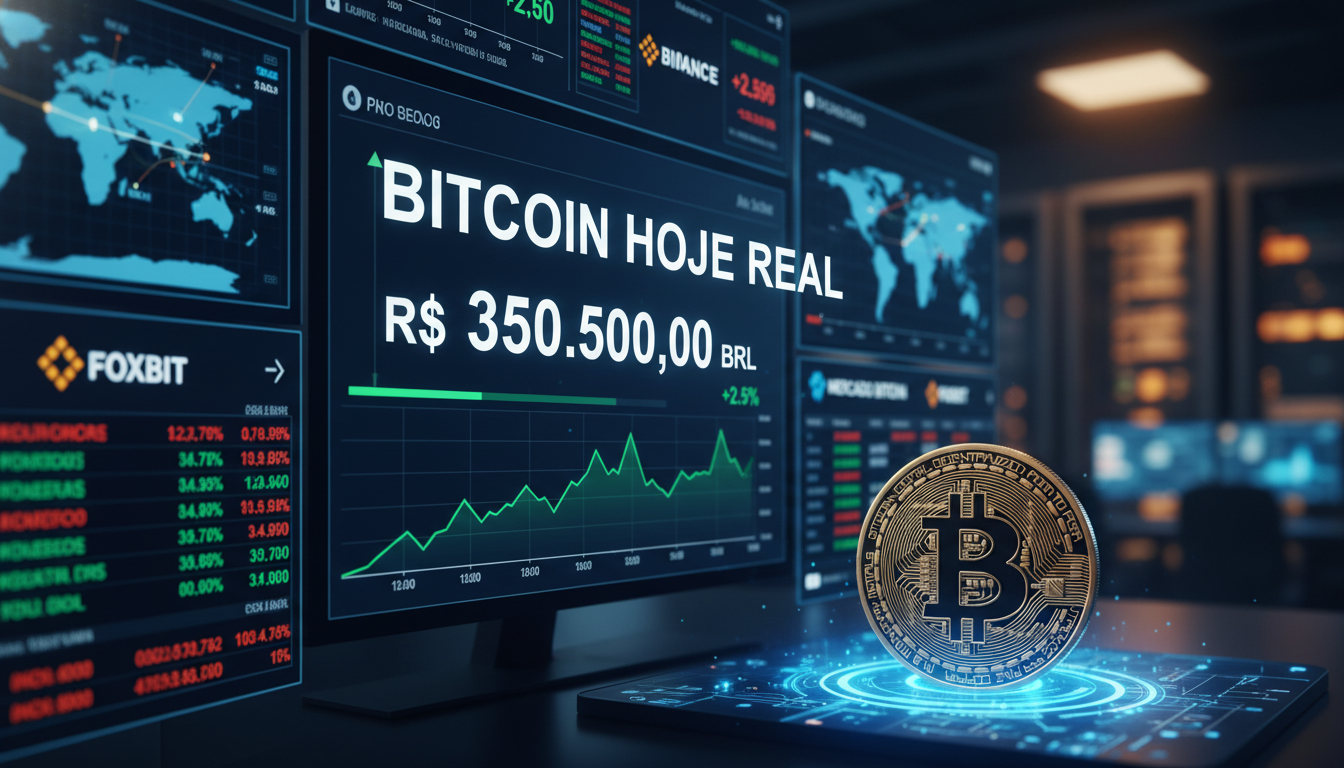
Navigating the world of Bitcoin today (“Bitcoin Hoje Real”), especially from Brazil’s perspective, is a bit like riding a wave that keeps shaping itself. The interplay between the BTC cotação in reais and broader economic shifts in Brazil reveals how a digital asset becomes both a speculative device and a socio-economic signal. In reality, this story is far from linear: it weaves in regulatory moves, investor behavior, and macroeconomic undercurrents that together shape Bitcoin’s evolving footprint in Brazil.
Macro Forces and Bitcoin Cotação in Brazil
Brazil’s currency volatility plays a major role in Bitcoin’s local positioning. The real’s sharp declines—once crashing to over R$6 against the US dollar—made Bitcoin more compelling for those fearing inflation or instability . Yet, Bitcoin hasn’t been immune to external shocks. Global uncertainty—from trade tensions to tech sector jitters—has translated into wild swings, often testing the confidence of Brazilian crypto adopters .
Meanwhile, the flat 17.5% crypto tax introduced in mid‑2025 significantly altered the calculus for many investors. Casual traders lost their modest exemptions, while high-net-worth participants sometimes benefited from a lower effective tax rate . And with reporting tightening and loss-offset windows set to shrink, the regulatory environment is anything but static.
Onboarded Investors: From Speculation to Strategy
A transformation is quietly underway. A report by Mercado Bitcoin reveals a 43% surge in crypto activity in 2025, with average investments per user surpassing R$5,700—around US$1,000 . Importantly, about 18% of users are now diversifying across assets like BTC, USDT, ETH, and SOL—moving away from one-dimensional bets . The adoption of lower-risk "renda fixa digital" products surged by 108%, showing that digital finance isn’t just about thrills anymore—it’s searching for yield .
Institutional influence is also growing. Itaú Asset Management now recommends a 1%–3% allocation to Bitcoin as a hedge against inflation, currency volatility, and geopolitical uncertainty . That’s a far cry from treating BTC purely as high-stakes speculation.
Market Sentiment and Price Movements
Bitcoin’s journey in Brazil is often punctuated by roller-coaster price shifts. For example, during times of macro optimism, it climbed beyond US$113,000—even as the real was under pressure . Yet at other points, Bitcoin fell sharply—trading below US$80,000 during sudden sentiment swings on global risk aversion . These fluctuations highlight how Brazil’s crypto market is closely tied not only to local tax and monetary policy, but also to external economic rhythms.
Expert Perspective on Brazil’s Crypto Journey
“Brazil is seeing a meaningful shift: Bitcoin is no longer just a speculative hobby. Increasingly, it’s woven into investment plans and risk frameworks.”
This reflects insights from analysts observing the 2025 trends. Between regulatory changes, more structured investing, and growing institutional recognition, Bitcoin's role is evolving in Brazil—and not always predictably.
Structural Headwinds and Opportunities Ahead
Looking further, a few developments are worth watching:
- Brazil’s tax environment: The flat 17.5% crypto tax is here to stay, but enforcement and reporting mechanisms may strengthen, and loss-offset rules tighten in 2026 .
- Digital real (Drex): The Central Bank is developing a digital version of the real—though privacy concerns have paused it mid-2025. If revived in 2026, Drex could shift how Brazilians pay and transact digitally .
- Macroeconomic shifts: Any movement in Brazil’s fiscal policy, inflation, or currency value can upend Bitcoin’s local narrative overnight.
Concluding Summary
In Brazil, Bitcoin’s daily prix en reais—or “Bitcoin Hoje Real”—is shaped by more than just charts. It's a reflection of regulatory reform, shifting investor sophistication, macroeconomic volatility, and evolving institutional strategies. The once purely speculative realm is maturing—gaining complexity, resilience, and unpredictability all at once.
FAQs
What is the current Bitcoin cotação in reais?
Exact prices fluctuate, but recent years saw it reach tens of thousands of reais. It closely tracks global BTC prices, adjusted for USD/BRL exchange rate.
How did the 17.5% crypto tax affect small investors?
It removed previous monthly exemptions, meaning even casual traders now owe significant taxes—even on modest gains.
Why do analysts suggest a 1%–3% Bitcoin allocation?
Institutions like Itaú view Bitcoin as a hedge against inflation and currency risk—non-correlated and globally accessible, offering strategic diversification.
What’s driving the growth in crypto activity in Brazil?
More Brazilians are shifting from speculative micromanagement to diversified, structured crypto portfolios, often through fixed-income digital products.
Could the digital real (Drex) replace Bitcoin’s role in payments?
Unlikely entirely—Drex may modernize fiat use, but Bitcoin remains a decentralized, global alternative valued for store-of-value properties.
Is Bitcoin adoption in Brazil mostly youth-driven?
Younger investors (under 24) grew sharply, but interest has expanded across all demographics, including high-net-worth and institutional participants.
Through changing regulations, shifting sentiment, growing sophistication, and digital infrastructure trends, Bitcoin’s story in Brazil feels raw, real, and very much alive.









Leave a comment