

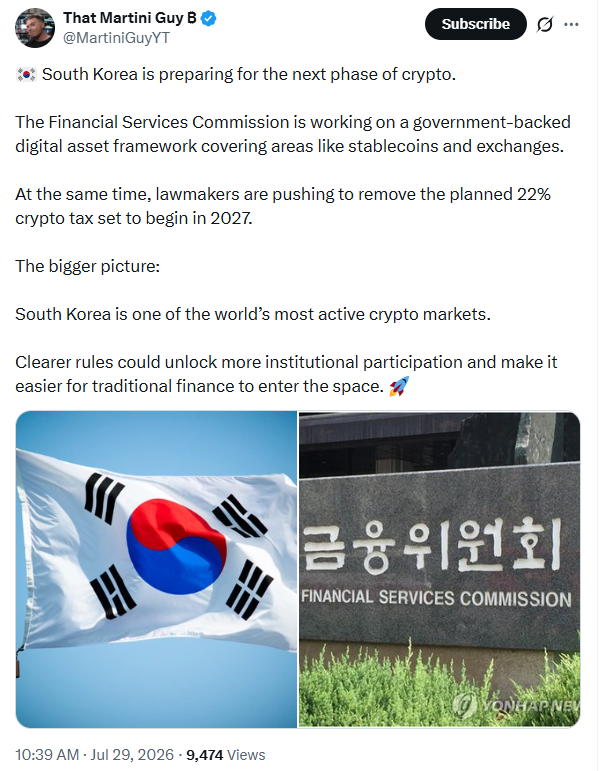
South Korea’s Financial Service Commission (FSC), along with the ruling Democratic Party, is reportedly planning to advance the Digital Asset Basic Act. The bill will unify 10 pending digital asset and stablecoin bills into a single consolidated proposal.
The Digital Asset Basic Act bill is finally moving forward after months of delays and uncertainty. It aims to provide clear regulations for cryptocurrencies and digital assets, with improved supervision of stablecoins.
At the same time, the crypto income tax bill is also under debate. The opposition party has proposed repealing the upcoming crypto income tax. The proposal argues that the bill is an unfair approach to the crypto industry.
The Digital Asset Basic Act Bill is Under Discussions
The Digital Asset Basic Act (DABA) addresses the major issues facing South Korea’s digital asset sector. The bill will establish clear rules for cryptocurrencies, issuance and circulation of stablecoins, and digital asset businesses.
It also sets exchange entry requirements, disclosure obligations, internal controls, and system resilience standards to provide a reliable trading environment.
According to reports, the proposal aims to consolidate 10 pending digital asset bills into a single Digital Asset Basic Act. This will create one single framework for lawmakers to negotiate rather than discussing separate drafts.
Some sources speculate the legislation is likely to be completed in the second half of 2026. However, the process has been slowed by disagreements over ownership and the repeal of the crypto tax bill.
Stablecoin Ownership and Exchange Limits Remain a Major Issue
The FSC has not yet announced a final date for the consolidation, as the two major disagreements remain unresolved in the process. One major dispute is the ownership of the stablecoin.
The Bank of Korea argues that won-denominated stablecoin issuers should be majority-owned by banks to ensure financial stability. This will provide banks with a leading role in the market. However, this creates debate over stablecoin risk and oversight measures.
Another major concern is whether to impose strict ownership limits on major crypto exchanges. The Virtual Asset Committee has previously discussed bank-led issuance, ownership dispersion, and internal controls at exchanges. But lawmakers have not reached an agreement on these provisions, delaying the process despite ongoing political discussions.
The Opposition Pushes to Repeal Upcoming Crypto Income Tax
The opposition has proposed a bill to abolish the country’s crypto income tax before it takes effect on 1 Jan 2027. This bill emphasizes imposing a 20% income tax plus a 2% local income tax on income exceeding 2.5 million won annually. Although it is not related to crypto regulations, this dispute is intensifying delays in the process.
The National Assembly’s Finance and Economic Planning Committee was scheduled to discuss this bill on Wednesday.
On 19 March, People Power Party lawmaker Song Eon-seok introduced a proposal to amend the Income Tax Act. The proposal states that it would delete the income tax provision that would charge income from the transfer or lending of digital assets.
Additionally, a separate petition for abolition, supported by 50,000 people, is set to go before a petitions subcommittee. However, reports say neither subcommittee has been formed nor any review dates finalized.
Disclaimer:
This page is for informational purposes only and should not be considered financial advice. Cryptocurrency investments carry significant risk. Price predictions are based on current analysis, may change without notice, and are not guaranteed to be accurate.