



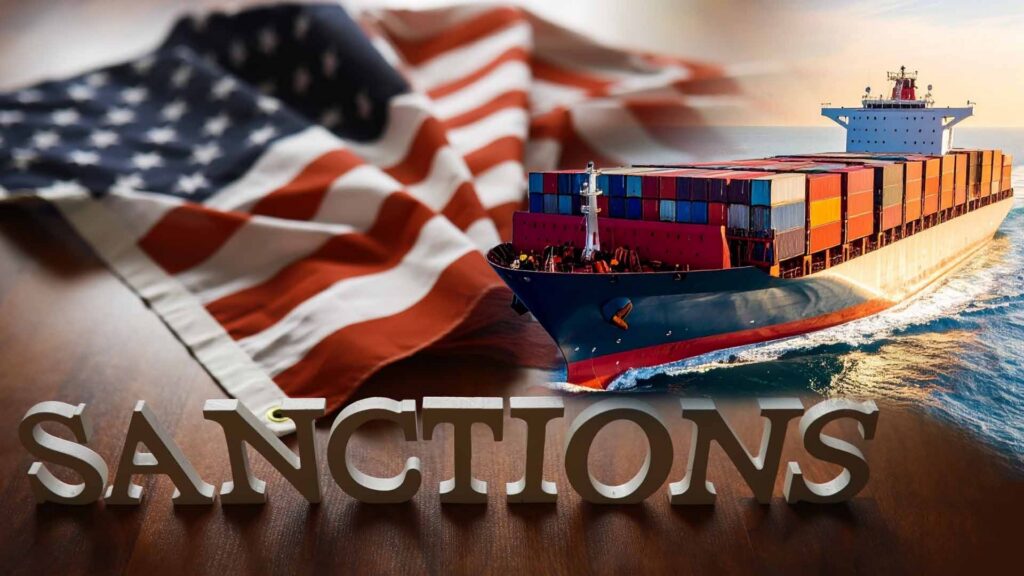
- The Office of Foreign Assets Control has sanctioned two Iranian maritime firms for evading US sanctions by accepting Bitcoin payments.
- Bitcoin has emerged as an alternative for sanctioned countries to facilitate international payments, even when traditional methods are blocked.
- The action intensifies economic pressure on Iran, making it difficult to transport its crude oil and petrochemical products.
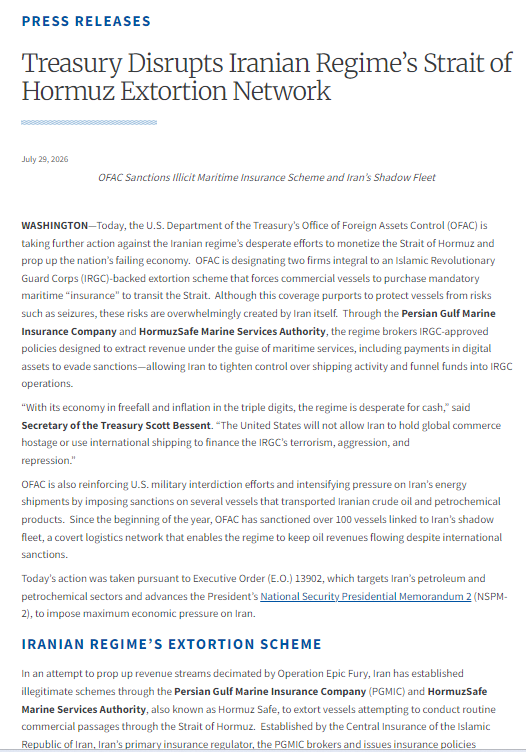
The U.S. Department of the Treasury’s Office of Foreign Assets Control (OFAC) recently sanctioned 2 Iranian firms. The names added to the list are Persian Gulf Marine Insurance Company and HormuzSafe Marine Services Authority.
The OFAC stated that these two Iranian maritime firms were an integral part of the IRGC-backed extortion network. This network is essential to enforce mandatory maritime “insurance” to transit the Strait of Hormuz.
The agency accused the companies of accepting Bitcoin to circumvent Western sanctions and finance IRGC activities.
OFAC’s Announcement on Recent US Sanctions
On July 29th, OFAC released a press release. In it, they accused the two firms of being a part of an “IRGC-backed extortion scheme.” Per the notification, they forced maritime insurance purchases to cross the strait.
These insurance policies cover risks such as vessel seizures and generate revenue to fund illegitimate activities.
Among the accused firms, one is HormuzSafe. It is an Iranian digital insurance platform. This company provides traffic control, security, and emergency response to vessels transiting the Strait of Hormuz. The Persian Gulf Marine Insurance Company is also involved in the same schemes.
The department stated that Iran’s Ministry of Economy established these entities to accept Bitcoin payments to evade sanctions. Iran intended to take control over their regional shipping by imposing this maritime insurance.
HormuzSafe and the Persian Gulf Marine Insurance Company have now come under OFAC’s radar for helping in Bitcoin sanctions evasion.
Why Do Many US-Sanctioned Companies Approach Cryptocurrencies?
US sanctions restrict access to the traditional global financial systems. This makes it difficult for countries to make international payments.
To tackle this challenge, sanctioned countries approach alternative methods to facilitate cross-border payments.
Bitcoin is the most preferred choice. Because it operates on a decentralized blockchain network, it becomes less likely to be traced.
Iran is doing the same. Per the official announcement, the country has established extortion schemes. These strategies help the regime accept Bitcoin payments to evade US sanctions.
What Does This Mean for the Crypto Industry?
The latest Iran crypto sanctions highlight that authorities continuously monitor and track illicit crypto activities used for US sanctions evasion.
Maritime trade has become a focal point for authorities, as the Strait of Hormuz is a key international trade chokepoint. It facilitates about 25% of the oil and LPG trade.
According to reports, OFAC has sanctioned over 100 vessels linked to Iran’s illegal shipping network this year. The authority is also strengthening the US military efforts to curb Iran’s international energy exports.
The case highlights the growing geopolitical tensions over international trade and cryptocurrency. Digital assets are increasingly becoming a part of regulatory discussions. It also raises questions about the security measures and use cases of emerging technologies.
Disclaimer:
This page is for informational purposes only and should not be considered financial advice. Cryptocurrency investments carry significant risk. Price predictions are based on current analysis, may change without notice, and are not guaranteed to be accurate.